
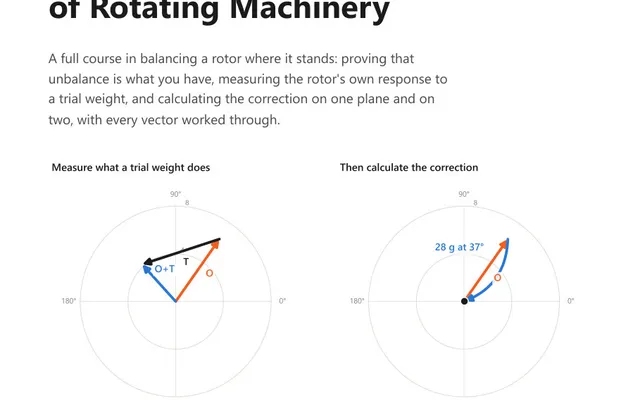
Field Balancing Training
A 56-page course book that works field balancing as vector arithmetic, on one plane and on two, for the analyst who has to correct a rotor in place.
Illustrated course books, written to be read cover to cover rather than skimmed. One per discipline and level.
A 56-page course book that works field balancing as vector arithmetic, on one plane and on two, for the analyst who has to correct a rotor in place.
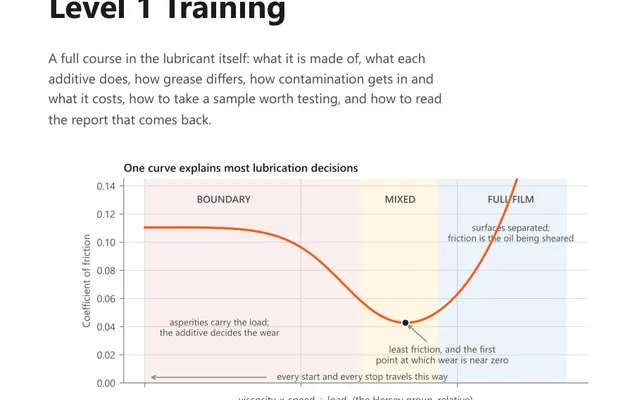
A 66-page course book on the lubricant itself, from the Stribeck curve to base oils, additives and grease, for the analyst who has to read a report.
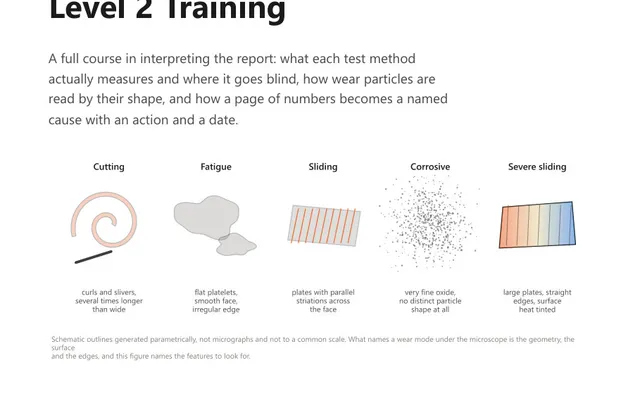
A 59-page course book on what each oil analysis test measures and where it fails, with the chapter on wear particle morphology that most books skip.
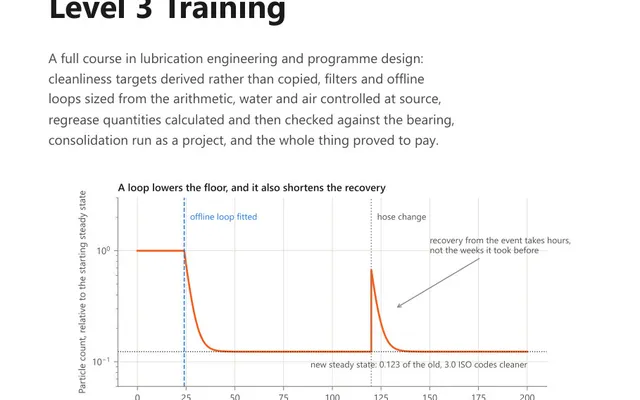
A 58-page course book on lubrication engineering: cleanliness targets, filter sizing, regrease quantity and varnish, worked for the machine at hand.
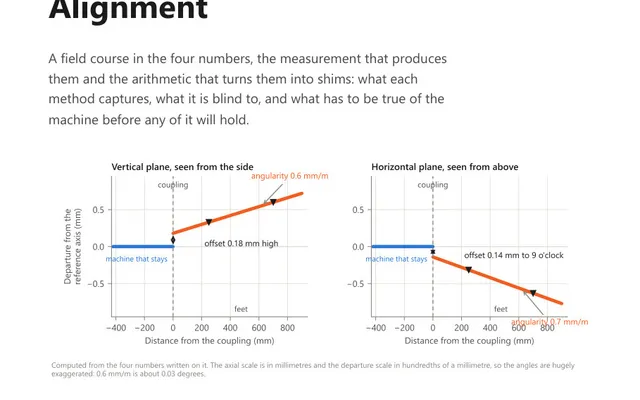
A 60-page course book that treats alignment as a calculation: offset, angularity, shim thickness and thermal growth, with the sign conventions worked.
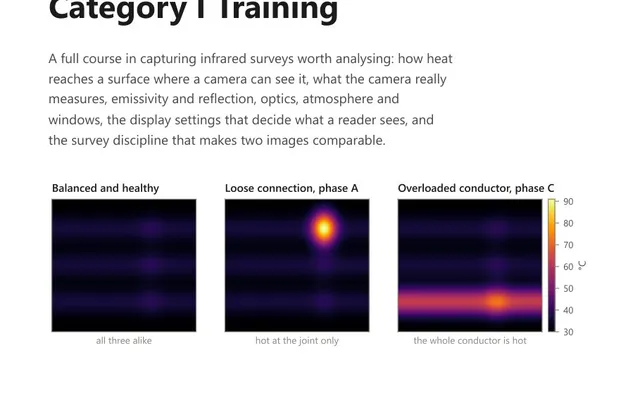
A 54-page course book for the thermographer who captures the images: how heat reaches a surface, emissivity, optics, and the conditions a survey needs.
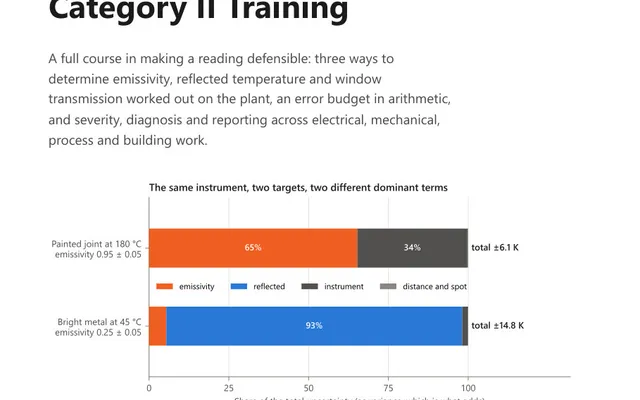
A 57-page course book on turning a thermal image into a defensible measurement, with emissivity determined on the surface and the error budget worked.
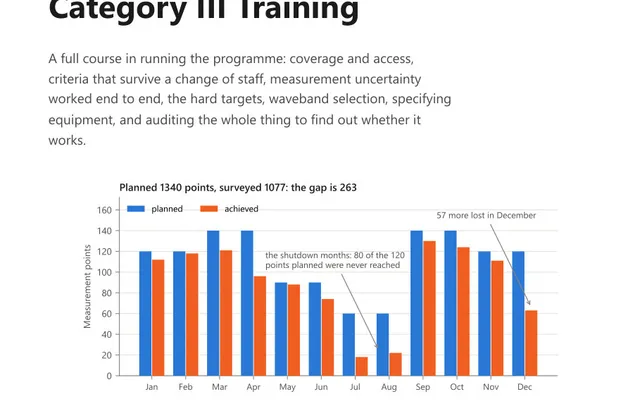
A 56-page course book for whoever owns the infrared programme: uncertainty quantified, criteria and procedures written, and the equipment specified.
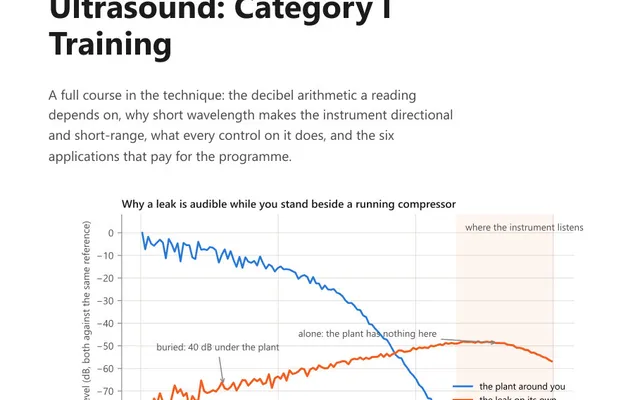
A 56-page course book on airborne and structure-borne ultrasound: decibels, directionality, the instrument's controls, leaks, steam traps and bearings.
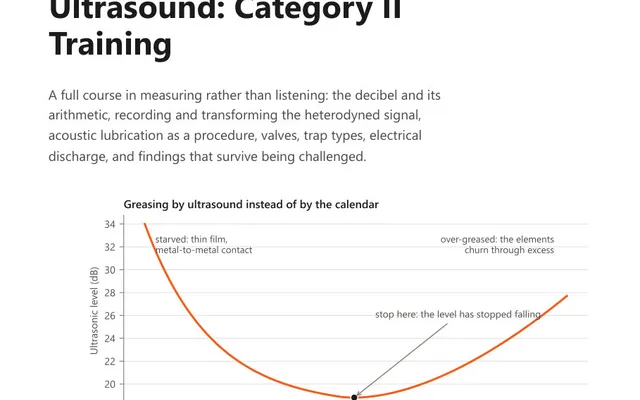
A 51-page course book on analysing the ultrasound signal: bearing condition, acoustic lubrication as a procedure, valve leakage and steam trap tests.
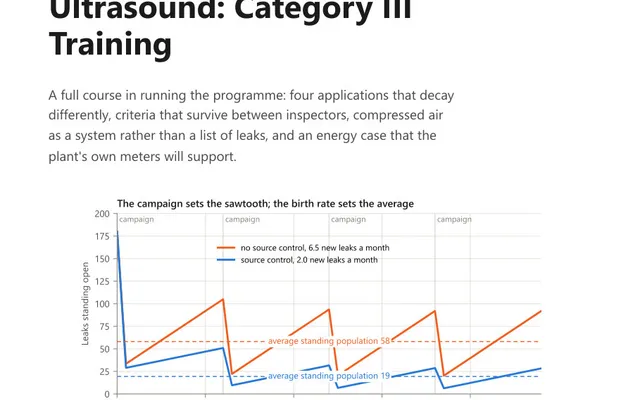
A 54-page course book for whoever owns the ultrasound programme: criteria that survive between inspectors, baselines and routes, compressed air as a system.
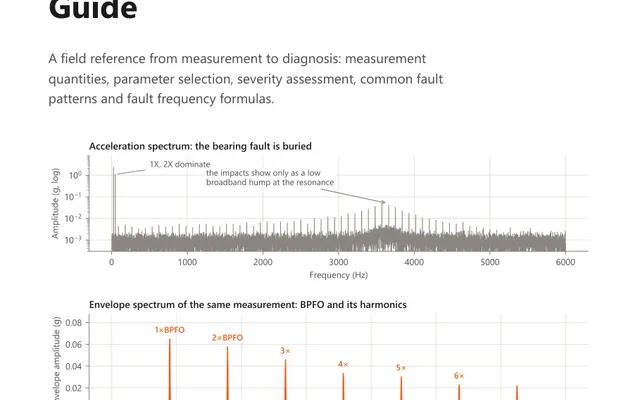
A 15-page field reference for the analyst on the route: measurement parameters, severity assessment, annotated fault spectra and bearing frequency formulas.
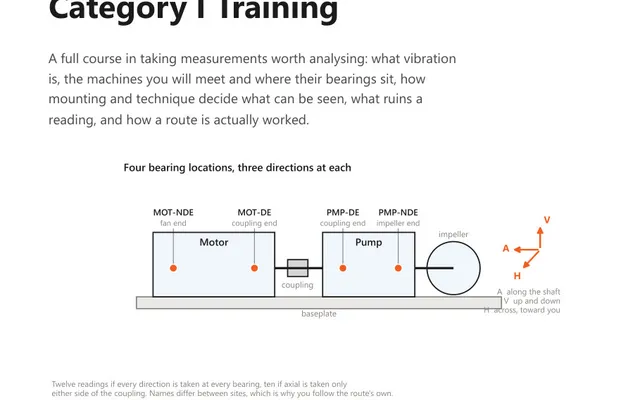
A 60-page course book for the analyst who collects the data: units, sensors and mounting, the machines you will meet, and a route worked end to end.
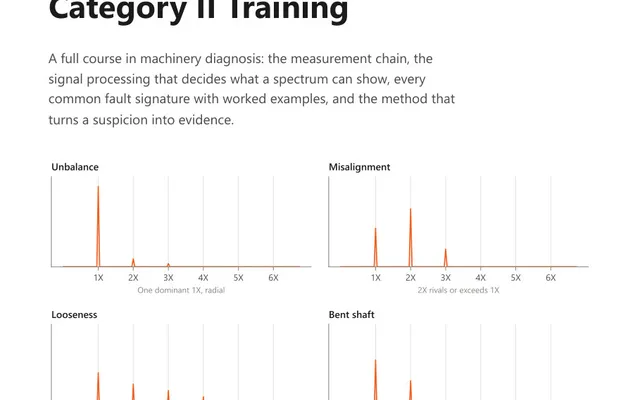
An 88-page course book on vibration diagnosis: which fault produces which pattern, what phase adds, and how to disprove an answer before reporting it.
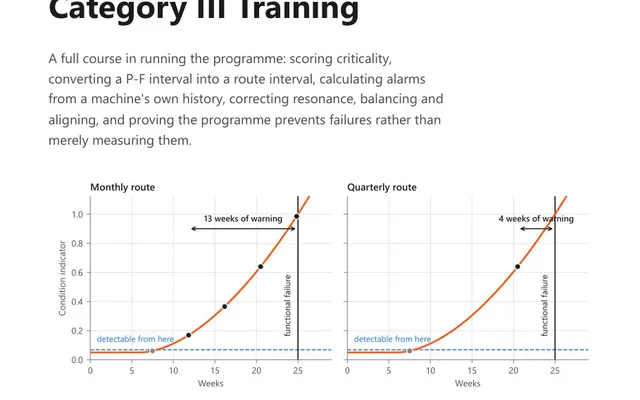
A 56-page course book on running the programme: criticality scoring, the P-F interval, and alarms calculated from the machine's own history, not a table.
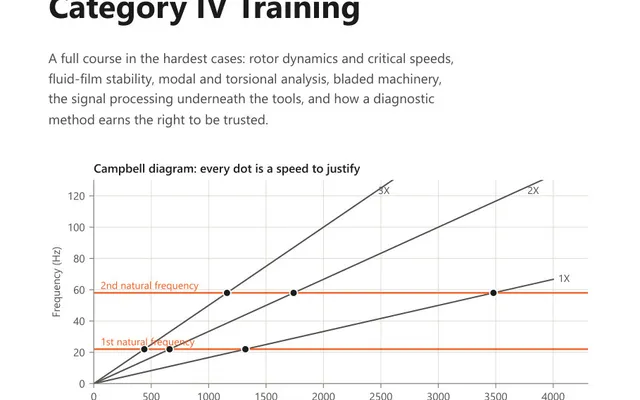
A 59-page course book on the hardest cases: rotor dynamics, critical speeds, torsional vibration and bladed machinery, with the arithmetic worked out.
Question sets at each level, every answer carrying a worked explanation rather than just a letter.
45 practice questions across shaft alignment and field balancing, from shim arithmetic to two-plane vector corrections, each answer worked in full.
41 practice questions on the lubricant itself, from viscosity and additives to sampling and reading a report, each answer worked rather than lettered.
37 practice questions on the oil analysis test methods, from viscosity and particle counting to wear particle morphology, each answer worked in full.

37 practice questions on lubrication engineering, from cleanliness targets and filter sizing to regrease intervals, each answer worked in full.
44 practice questions on capturing a survey worth analysing, from emissivity and reflection to optics and spot size, each answer worked in full.
38 practice questions on making a thermal reading defensible, from determining emissivity to the error budget, each answer worked rather than lettered.
30 practice questions on running a thermography programme, from coverage and criteria to quantified uncertainty, each answer worked rather than lettered.
43 practice questions on airborne and structure-borne ultrasound, from decibels and heterodyning to leaks and bearings, each answer worked in full.
37 practice questions on analysing an ultrasound signal, from decibel arithmetic to bearing condition and acoustic lubrication, with worked answers.

32 practice questions on running an ultrasound programme, from criteria and baselines to compressed air as a system, each answer worked in full.
40 practice questions on taking a reading worth trending, from units and sensor mounting to what ruins a measurement, each answer worked rather than lettered.
58 practice questions on vibration diagnosis, from fault signatures and phase to bearings, gears and resonance, each answer worked rather than lettered.
42 practice questions on running a vibration programme, from criticality and the P-F interval to alarm arithmetic, each answer worked rather than lettered.
35 practice questions on the hardest cases: rotor dynamics, critical speeds, fluid-film stability and torsional analysis, each answer worked in full.
The arithmetic of the job, worked in the browser. Open, free, and nothing to install.
Calculate BPFO, BPFI, BSF and FTF from bearing geometry, from the manufacturer's frequency factors, or from the rolling element count alone.
Work out bin spacing, real peak separation, block time and total acquisition time from Fmax, lines of resolution, window function, averages and overlap.
Gear mesh and hunting tooth, belt frequency, induction motor slip and pole pass, and blade pass. The frequencies a machine produces because of how it is built.
Place a broadband RMS velocity reading in the ISO 20816-3 evaluation zones by machine group and support class, and test it against the change criterion.
Convert vibration between acceleration, velocity and displacement at a single frequency, in g, m/s², mm/s, in/s, µm and mil, RMS, peak or peak to peak.
Work out the permissible residual unbalance for an ISO 21940-11 balance quality grade, in gram millimetres and as the correction mass at your own radius.
Solve a single plane trial weight balance as vectors: correction mass and angle from an original run and a trial run, with the answer for leaving the trial mass on.
Solve a two plane balance from three runs: four complex influence coefficients, and the correction mass and angle for each plane, by Cramer's rule.
Check coupling offset and angularity against the speed-based tolerance the trade uses, and get the vertical and horizontal move each foot needs to come into line.
How far each machine's shaft centreline rises as it warms, and the cold vertical offset that difference is worth when the two machines grow by different amounts.
The true surface temperature behind a thermal reading taken at the wrong emissivity, with reflected temperature and the sensitivity to a 0.05 error.
Find the spot size a thermal camera measures at a given distance from its IFOV or its field of view, and the smallest target it can read honestly.
Work out ΔT against an identical component, the point's own history or ambient air, project it to rated load as a range, and place it against your criterion.
Convert particle counts at 4, 6 and 14 micrometres into an ISO 4406 cleanliness code, see the range behind every digit, and compare the oil against a target.
Work out the grease quantity from a bearing's outside diameter and width, then adjust the maker's relubrication interval for heat, orientation and dirt.
Work out kinematic viscosity at any operating temperature from the 40 and 100 degree figures on an oil data sheet, using the Walther equation behind ASTM D341.
Work out how much free air a compressed air leak loses and what that air is worth over a year, from the hole diameter, the line pressure and your own specific power.
Estimate the steam a failed trap passes from its orifice diameter and line pressure using Napier's equation, then turn that flow into tonnes and cost per year.
Turn a decibel rise over baseline into an amplitude ratio with the trade's bearing thresholds, and find the wavelength of ultrasound in air.
Multiply severity, occurrence and detection to get the FMEA risk priority number, with severity times occurrence read beside it.
Calculate ISO 281 basic rating life from the dynamic load rating, the equivalent dynamic load and the speed, in millions of revolutions and in running hours.
Calculate MTBF, MTTR, availability and failure rate from operating hours and a failure count, plus the odds of completing a mission.
Work out availability, performance, quality and overall equipment effectiveness from a shift's planned time, downtime and piece counts.
Turn a P-F interval and a response time into the usable window and the longest inspection interval that still catches the fault in time.