

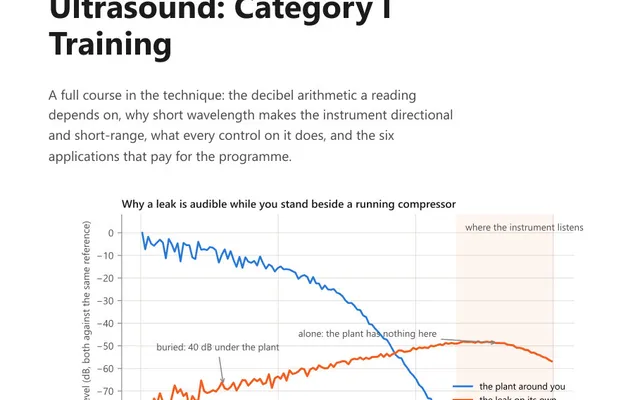
Ultrasound Training: Category I
A 56-page course book on airborne and structure-borne ultrasound: decibels, directionality, the instrument's controls, leaks, steam traps and bearings.
Napier’s equation gives the steam escaping through a failed trap as 24.24 times the absolute upstream pressure in psia times the orifice area in square inches, in pounds per hour, and that is a ceiling rather than a measurement. The calculator does the unit conversion from millimetres and bar gauge, applies a fraction for the part of the flow that is really steam, and carries the result through to tonnes and money per year.
Above roughly half the absolute upstream pressure, flow through an orifice chokes. The steam reaches sonic velocity in the throat and the mass flow stops responding to the downstream pressure altogether, so the rate depends on the orifice area and the absolute upstream pressure alone. A trap discharging to atmosphere or into a low pressure condensate return is comfortably in that regime.
Napier wrote that condition for steam as:
where W is the flow in pounds per hour, P the absolute upstream pressure in pounds per square inch, and A the orifice area in square inches. Everything else is arithmetic on the units:
Two things follow from the shape of the equation. The loss is linear in absolute pressure, so the same worn seat on a 20 bar header loses about twice what it loses on a 10 bar one. And it goes with the square of the diameter, so a seat that has wire drawn from 3 mm to 4.5 mm is passing more than twice the steam it did.
The equation describes a clean round orifice passing dry saturated steam. A failed trap is rarely either of those things.
The seat of a trap that has blown is wire drawn and irregular rather than round, and its effective flow area is not the catalogue orifice. More importantly, most failed traps pass condensate alongside the steam, and condensate carries a small fraction of the energy per kilogram that steam does. A trap that is leaking rather than blown wide open may be passing steam for only part of the time or over only part of the seat area.
That is what a fraction passing steam is for. Set it to 1 for a trap that has failed wide open and blows continuously, and to something lower for one judged to be leaking. It is a judgement made during the survey, and it is the honest place to put the uncertainty. A survey that assumes every failed trap is a wide open orifice will overstate the total, and an overstated total is the fastest way to lose the credibility of the next survey.
A tonne of steam costs what the fuel costs, divided by the boiler efficiency, plus makeup water, treatment chemicals, and the losses in the distribution system before the steam reaches the trap. None of those is a constant, and two plants on the same street can differ by half.
No figure is published here for that reason. Take it from the boiler house, because it multiplies every other number in the calculation: a loss estimate that is right to within ten percent, priced with a steam cost that is wrong by a factor of two, is wrong by a factor of two.
A trap with a 3 mm seat orifice on a 10 bar gauge line, failed wide open, so the whole orifice flow is steam.
Nineteen kilograms an hour through a hole three millimetres across. If that line carries steam for 8000 hours a year, it is about 154 tonnes from one trap, which is the number that makes trap surveys pay for themselves. Price it with your own cost per tonne and the argument writes itself.
If the same trap were judged to be leaking rather than blown, and the survey put half its flow down as steam, the loss would be 9.6 kg/h and about 77 tonnes a year. Same trap, same pressure, a different reading of what it is doing.
None of the arithmetic matters until you know which traps have failed, and a trap gives no useful outside sign of failing open. It does not necessarily run hotter than a working one, since both are full of steam at times, and a thermal camera on its own struggles to separate a trap that is discharging normally from one that never closes.
Ultrasound separates them, because it hears the flow rather than the temperature. A working trap cycles: it fills, discharges and closes, and through the body that sounds like an intermittent event with silence between. A trap that has failed open passes steam continuously, and continuous flow through a small orifice is a steady, unbroken high frequency hiss.
That difference is audible through the trap body with a contact probe while the plant is running, which is what makes a trap survey a route rather than an outage task. Listen upstream and downstream of the trap, note the pressure and the orifice size from the data sheet, and record a judgement on how much of the flow is steam. Those three things are all the estimate needs.
The upper bound comes from Napier's equation for choked flow through an orifice, which gives the loss in pounds per hour as 24.24 times the absolute upstream pressure in psia times the orifice area in square inches. A 3 mm seat orifice at 10 bar gauge works out at roughly 19 kg of steam per hour if it is passing steam continuously. Most failed traps pass some condensate as well and lose less than that ceiling.
Napier's equation states that steam flow through a choked orifice, in pounds per hour, is 24.24 multiplied by the absolute upstream pressure in pounds per square inch and by the orifice area in square inches. It is a straight-line relationship in pressure, which is why doubling the line pressure roughly doubles the loss through the same hole. Metric inputs have to be converted before it is applied.
Because the flow is choked. Once the pressure downstream of an orifice falls below roughly half the absolute upstream pressure, the steam reaches sonic velocity in the throat and the mass flow stops responding to anything happening further downstream. From that point the rate depends only on the orifice area and the absolute upstream pressure, which is exactly the condition a trap discharging to atmosphere or to a low pressure return line is in.
Multiply the steam loss in kilograms per hour by the hours per year the line carries steam, divide by a thousand to get tonnes, and multiply by the cost of a tonne of steam at that site. The cost figure has to come from the boiler house, since it depends on the fuel price, the boiler efficiency, water and treatment, and distribution losses. Two plants on the same street can differ by half.
With ultrasound. A trap that has failed open passes steam continuously, and continuous flow through a small orifice radiates a steady high frequency hiss, while a healthy trap cycles between discharge and closure. That difference is audible through the trap body with a contact instrument while the plant is running, which turns a trap survey into a routine route rather than an outage task. Temperature readings support the diagnosis.
The calculator gives you the number. These course books explain what the number means and how the measurement that produced it should be taken.
A 56-page course book on airborne and structure-borne ultrasound: decibels, directionality, the instrument's controls, leaks, steam traps and bearings.

A 54-page course book for whoever owns the ultrasound programme: criteria that survive between inspectors, baselines and routes, compressed air as a system.
32 practice questions on running an ultrasound programme, from criteria and baselines to compressed air as a system, each answer worked in full.