

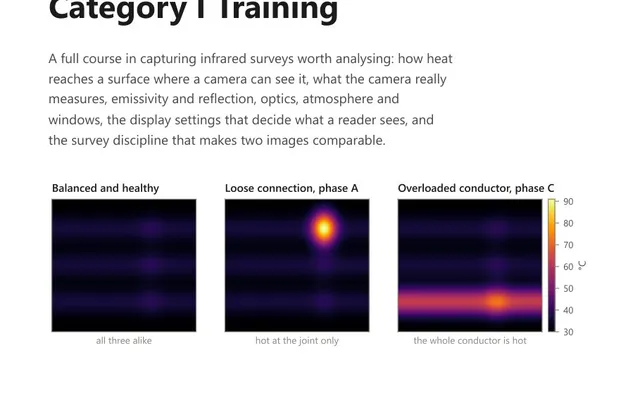
Infrared Thermography Training: Category I
A 54-page course book for the thermographer who captures the images: how heat reaches a surface, emissivity, optics, and the conditions a survey needs.
Spot size in millimetres is the camera’s IFOV in milliradians multiplied by the distance in metres, and the smallest target you can actually measure is that spot multiplied by the number of pixels the target has to span. Seeing a hot object and measuring it are different achievements, and the gap between them is where most bad thermography numbers come from.
A thermal camera will show a hot terminal from across a substation yard. It will also report a temperature for it, and that temperature may be nowhere near the truth, because the terminal is filling a fraction of one pixel and the rest of that pixel is the sky behind it.
A detector element averages everything inside its own cone of view. If a hot bolt fills half of that cone, the reported temperature is roughly the average of the bolt and the background, which is almost always cooler than the bolt. This is why a small hot object nearly always reads low, and why walking closer raises the reading instead of lowering it. An inspector who has never watched that happen tends to assume the first reading was right.
Everything follows from one convenient coincidence: a milliradian at one metre subtends one millimetre.
IFOV from the camera’s specification. If the data sheet quotes IFOV in milliradians, use it directly. If it quotes a field of view and a detector resolution instead:
IFOV (mrad) = 2 × tan(field of view / 2) × 1000 / horizontal pixels
The detector sits on a flat focal plane, so what the lens projects across it is 2 × tan(FOV / 2) wide and the elements divide that width between them. The shortcut usually printed instead, degrees × 17.4533 / pixels, is the small angle approximation of the same thing. It is fine on a narrow lens and it is not fine on a wide one: it is out by 0.4 per cent at 12 degrees, 5 per cent at 45, 17 per cent at 80 and 40 per cent at 120, and it is always low, which is the dangerous direction. An understated spot tells you a smaller target is measurable than really is.
Use the horizontal field of view with the horizontal pixel count; mixing the horizontal angle with the vertical pixel count is a common and silent error.
Spot size at a distance.
spot (mm) = IFOV (mrad) × distance (m)
The distance-to-spot ratio, in the sense a data sheet publishes it.
ratio = 1000 / IFOV (mrad)
The smallest target worth measuring, with the pixel rule applied on top.
smallest measurable target (mm) = spot (mm) × pixels needed
The furthest useful distance for a target you already have.
furthest useful distance (m) = target size (mm) / (IFOV (mrad) × pixels needed)
The ratio a given target demands at a given distance.
required ratio = distance (mm) / (target size (mm) / pixels needed)
Target size means the smallest dimension of the thing being measured. A busbar 300 mm long and 8 mm thick is an 8 mm target.
Three pixels across the target is the usual minimum, five is comfortable, and ten gives a reading you can hold to the camera’s stated accuracy. The reason is not fussiness. A detector’s response does not stop cleanly at the edge of a pixel, so a target that exactly fills one pixel is still being contaminated by its neighbours. Asking for three or more puts a core of pixels in the middle that see nothing but the target.
Below three pixels the reading falls low. Below one pixel it means nothing at all.
A 320 by 240 camera with a 24 degree horizontal field of view, used at 5 metres on a 25 mm bolt head, with three pixels demanded across the target.
IFOV = 2 × tan(12°) × 1000 / 320 = 1.33 mrad.
At 5 metres the measurement spot is 1.33 × 5 = 6.64 mm, and the camera’s distance-to-spot ratio is 1000 / 1.33 = 753 to 1. That ratio belongs to the camera, not to the job: it is the same at 5 metres and at 50.
Now the pixel rule, applied to the spot rather than folded into the ratio. The smallest measurable target at 5 metres is 6.64 × 3 = 19.9 mm. The 25 mm bolt spans 25 / 6.64 = 3.8 spot diameters, which is enough to measure, and the furthest useful distance for that bolt is 25 / (1.33 × 3) = 6.27 m, so there is very little margin left.
Take the same camera to 20 metres and the spot is 26.6 mm. The 25 mm bolt is now smaller than the spot. The camera will still draw it, still put a cursor on it, and still print a number in the report, and that number will be meaningless.
Turned round, the same arithmetic writes a specification. A 15 mm lug that can only be approached to 3.0 metres needs a spot of 15 / 3 = 5 mm, so it needs a ratio of 3000 / 5 = 600 to 1 at that distance. Ask a supplier which lens in their range reaches 600 to 1 and what field of view that costs. Quoting 3000 / 15 = 200 to 1 instead is the folded-in mistake, and it buys a camera whose spot covers the entire lug.
A published distance-to-spot ratio describes the measurement spot on its own: the working distance divided by the diameter of that spot, with no rule of thumb inside it. A 250 to 1 camera has a 40 mm spot at 10 metres. A 40 mm target at that distance therefore exactly fills the spot, which is precisely the condition the three pixel rule exists to prevent; the rule is applied on top, and it asks for a target nearer 120 mm before the reading is a temperature.
That is why the ratio on this page does not move when you change the pixel count and the smallest measurable target does. A figure that shifts with the pixel count is not a distance-to-spot ratio and cannot be compared with a data sheet. Material circulates that folds the three pixel rule into the ratio and then quotes the result as one; for the same camera it comes out three times smaller.
Two things follow for a specification. It is always a ratio and a distance together, because a ratio alone answers nothing. And detector resolution answers a different question again: pixels on the target decide what can be seen, the spot decides what can be measured, and a hot spot one pixel across is visible and is not measurable.
Halving the field of view halves the IFOV and doubles the working distance for the same target. Where equipment cannot be approached, which is most of the reason anyone is measuring it from a distance in the first place, a telephoto lens does what walking closer would have done.
The other lever is detector resolution. Doubling the horizontal pixel count halves the IFOV just as effectively as halving the field of view, and it does so without narrowing what you can see in one frame. That is the real difference between a 160 by 120 camera and a 640 by 480 one: not the picture, but how far away it can still tell you a temperature.
When neither is available, the honest response is to record the distance and the spot size alongside the reading, and to say in the report that the target was undersampled. A number with its limitations attached is worth something. A number presented as a measurement when the target filled a third of a pixel is worth less than nothing, because somebody will act on it.
IFOV, the instantaneous field of view, is the angle one detector element sees, normally quoted in milliradians. It is twice the tangent of half the horizontal field of view, divided by the number of horizontal pixels, expressed in milliradians. The familiar shortcut of degrees times 17.4533 over pixels is the small angle approximation of that expression, and it understates the spot by about 5 per cent on a 45 degree lens and far more on anything wider. Because a milliradian at one metre subtends one millimetre, IFOV in milliradians is also the width in millimetres one pixel covers at one metre.
Spot size in millimetres is the IFOV in milliradians multiplied by the distance in metres, since one milliradian at one metre subtends one millimetre. That gives the width one pixel covers. The smallest target that can be measured rather than merely seen is that spot multiplied by the number of pixels the target must span, commonly three as a minimum, five for comfort and ten for an accurate reading.
Because a detector element averages everything inside its own cone of view. If a hot bolt fills half of that cone, the temperature reported is roughly the average of the bolt and the background behind it, and the background is nearly always cooler. Small hot objects therefore read low, and the error grows with distance as the cone widens. Moving closer raises the reading rather than lowering it.
That the measurement spot is 40 mm across at 10 metres, since 10 metres divided by 250 is 40 millimetres. A published ratio describes that spot on its own, with no rule of thumb folded into it, which is why it does not change when you decide how many pixels you want across a target. The pixel rule is applied to the spot afterwards, as a separate step: at 250 to 1 and ten metres a target has to be around 120 mm across before the reading is a temperature rather than a blend.
Three pixels is the usual minimum, five is comfortable and ten gives a reading that can be trusted to the camera's stated accuracy. Below three, edge pixels are averaging the target with its background and the reading falls low. Below one pixel the camera will still display the object and the temperature it reports is meaningless. The requirement applies to the target's smallest dimension, not its largest.
The calculator gives you the number. These course books explain what the number means and how the measurement that produced it should be taken.
A 54-page course book for the thermographer who captures the images: how heat reaches a surface, emissivity, optics, and the conditions a survey needs.
44 practice questions on capturing a survey worth analysing, from emissivity and reflection to optics and spot size, each answer worked in full.