

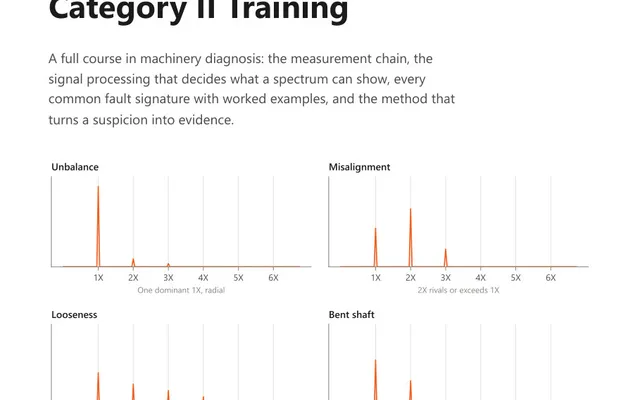
Vibration Analysis Training: Category II
An 88-page course book on vibration diagnosis: which fault produces which pattern, what phase adds, and how to disprove an answer before reporting it.
The ISO 281 basic rating life is L10 = (C/P)^p in millions of revolutions, and the same life in running hours is L10h = (10^6 / (60 n)) times (C/P)^p. The exponent p is 3 for ball bearings and 10/3 for roller bearings, and what comes out is a statistical life for a population of bearings rather than a date for the one on the machine.
C is the basic dynamic load rating, taken from the catalogue for the bearing as specified. P is the equivalent dynamic load, which is what the bearing actually carries. n is the speed in revolutions per minute. The factor 10^6 / (60 n) does nothing clever: it converts millions of revolutions into hours, since 60 n is the number of revolutions the shaft makes in an hour.
Only the ratio of C to P matters, not the two figures separately. A bearing rated at 52.7 kN carrying 8.5 kN and a much larger bearing rated at 527 kN carrying 85 kN have exactly the same rating life at the same speed.
For ball bearings p is 3, and for roller bearings it is 10/3. A roller carries its load along a line rather than at a point, and the fitted exponent is steeper to match, so the same proportional reduction in load buys a roller bearing slightly more life than it buys a ball bearing. Picking the wrong one is a quiet error, because both exponents return a number that looks entirely plausible.
For a purely radial load, P is the radial force. For a combined load it is X times the radial force plus Y times the axial force, with X and Y taken from the catalogue for that bearing. There is no general formula for X and Y; they belong to the bearing rather than to the equation.
This input matters more than any other, because P is raised to the third power. A radial force taken off a belt tension calculation, an axial force nobody measured, a misalignment the drawing does not show: each of those lands in P, and each is then cubed. An answer quoted to three figures on a load known to fifty percent is decoration.
The basic rating life is defined at 90 percent reliability. That is the whole of its meaning: 90 percent of a large group of identical bearings reaches it, which is the same as saying one in ten is expected to fail sooner. Where a higher survival probability is required, ISO 281 supplies a factor a1 that multiplies the life.
| Reliability | a1 |
|---|---|
| 90% | 1 |
| 95% | 0.64 |
| 96% | 0.55 |
| 97% | 0.47 |
| 98% | 0.37 |
| 99% | 0.25 |
That column reads as a price list. Moving the requirement from 90 percent to 99 percent leaves a quarter of the life, and no bearing has changed and no load has changed. It is also why a life figure quoted without its reliability basis says less than it appears to: the same bearing under the same load has six different lives here, depending only on which survival probability was asked for.
Life goes with the cube of C over P for a ball bearing, so halving the load multiplies the life by eight. A bearing that lasts a year at one load lasts eight years at half of it.
That is why the useful question about a short-lived bearing is almost never which brand to buy next, and almost always what is loading it. Belt tension set by feel, a coupling pulling the shaft, a pump running well off its best efficiency point, a soft foot: all of them add load, all of them land in P, and all of them are cheaper to correct than a bearing that keeps coming back.
Above roughly half the basic dynamic load rating, contact stress leaves the range the rating life equation was fitted over, and the number it returns stops meaning very much. The calculator says so rather than printing the figure without comment. If P is more than half of C, what needs checking is the load case and whether the bearing is the right size for it, not the arithmetic.
A ball bearing with a basic dynamic load rating of 52.7 kN, carrying an equivalent dynamic load of 8.5 kN, at 1480 rpm.
At 95 percent reliability the factor a1 is 0.64, and 0.64 × 2684 = 1718 hours. P is 8.5 kN against a half rating of 26.35 kN, so the equation is being used well inside the range it was fitted over.
Two thousand seven hundred hours is a short life for a bearing that is not obviously overloaded, and the speed is what does it: at 1480 rpm those 238 million revolutions go by in a little under four months of continuous running. The same bearing under the same load at a tenth of the speed would show ten times the hours, because hours are revolutions divided by speed and nothing in L10 knows about time at all.
This is the basic rating life: the life 90 percent of a large group of identical bearings reaches under clean, well lubricated, correctly mounted conditions. ISO 281 also defines a modified rating life that accounts for lubrication and contamination, and on a real machine those usually matter more than the arithmetic here. A bearing fed dirty grease will not reach its basic rating life, and nothing in the equation knows that.
So read the result as a ceiling rather than a forecast. A bearing that falls a long way short of it is a question about mounting, load or lubrication, and almost never a question about the bearing.
L10 is the basic rating life defined in ISO 281: the life that 90 percent of a large group of identical bearings reaches or exceeds before rolling contact fatigue appears, expressed in millions of revolutions. It is calculated as the basic dynamic load rating C divided by the equivalent dynamic load P, raised to the power 3 for ball bearings or 10/3 for roller bearings.
By dividing by the number of revolutions the shaft makes in an hour. The expression is L10h = (10^6 / (60 n)) times (C/P)^p, with n in revolutions per minute. A bearing whose C over P ratio is 6.2 has a rating life of 238 million revolutions, and at 1480 rpm that works out at roughly 2684 hours, a little under four months of continuous running.
It is the multiplier that converts the basic rating life, which is defined at 90 percent reliability, into a life at a higher survival probability. ISO 281 gives a1 as 1 at 90 percent, 0.64 at 95 percent, 0.55 at 96 percent, 0.47 at 97 percent, 0.37 at 98 percent and 0.25 at 99 percent. Requiring 99 percent of bearings to survive therefore leaves a quarter of the calculated life.
Because the rating life equation raises the ratio of load rating to load to the third power for a ball bearing. Halving the load doubles that ratio, and two cubed is eight. The practical consequence is that the answer to a bearing failing again and again is almost never a different brand of bearing and almost always whatever is loading it: belt tension, misalignment, or an axial force nobody measured.
No. It is a statistical life for a population, at 90 percent reliability, under clean, well lubricated and correctly mounted conditions, and one bearing in ten is expected to fail before it. ISO 281 also defines a modified rating life that accounts for lubrication and contamination, and on a real machine those usually decide the outcome. Read the figure as a ceiling rather than a forecast.
The calculator gives you the number. These course books explain what the number means and how the measurement that produced it should be taken.
An 88-page course book on vibration diagnosis: which fault produces which pattern, what phase adds, and how to disprove an answer before reporting it.
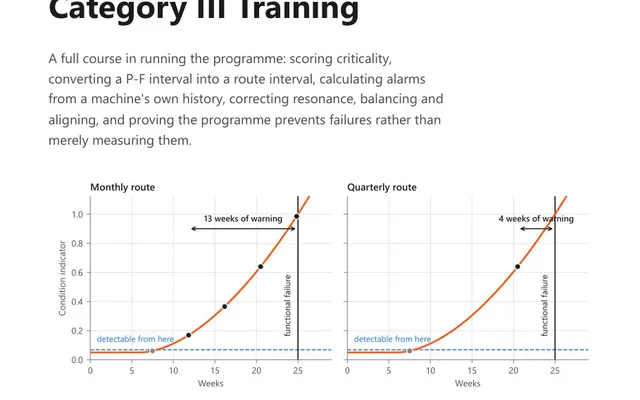
A 56-page course book on running the programme: criticality scoring, the P-F interval, and alarms calculated from the machine's own history, not a table.
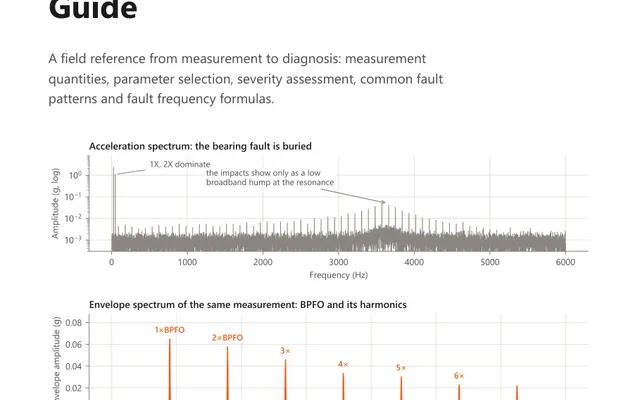
A 15-page field reference for the analyst on the route: measurement parameters, severity assessment, annotated fault spectra and bearing frequency formulas.