

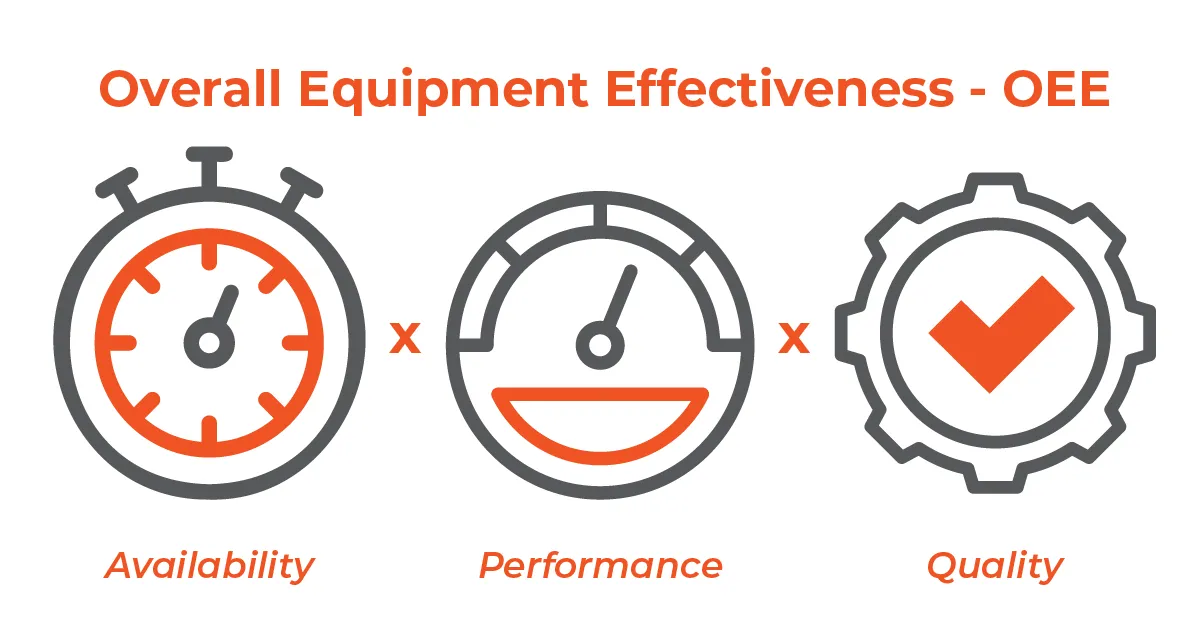
Overall Equipment Effectiveness (OEE) is a single manufacturing metric (the product of availability, performance, and quality) that expresses how much of the scheduled production time a machine actually spends making good parts at full speed. OEE serves as a comprehensive measure of equipment performance, providing insights into how well equipment is utilized, how effectively it operates, and where improvements can be made. This introductory sheet aims to elucidate the concept of OEE, its significance, and the calculations involved.
Understanding Overall Equipment Effectiveness (OEE)
Overall Equipment Effectiveness (OEE) is a metric used to evaluate the performance of manufacturing equipment in terms of its efficiency and productivity. It provides a holistic view of equipment performance by considering three key factors: availability, performance, and quality. OEE enables manufacturers to identify areas of inefficiency, reduce downtime, enhance productivity, and ultimately improve the bottom line through predictive maintenance and condition monitoring solutions.
Components of OEE
-
Availability: Availability refers to the percentage of time that equipment is available for production during scheduled production time. It takes into account factors such as equipment breakdowns, changeovers, and planned maintenance. Maximizing availability involves minimizing downtime and ensuring that equipment is operational when needed. Techniques such as Failure Mode and Effect Analysis (FMEA) and online condition monitoring can be used to identify potential failure points and enhance equipment reliability.
-
Performance: Performance measures the speed at which equipment operates relative to its optimal speed. It accounts for factors such as slow cycles, idling, and minor stoppages that affect the overall speed of production. Improving performance involves identifying and addressing bottlenecks, optimizing workflows, and maximizing equipment throughput. Implementing industrial condition monitoring and predictive maintenance sensors can significantly contribute to identifying performance issues early on.
-
Quality: Quality evaluates the percentage of good-quality products produced relative to the total output. It considers defects, rework, scrap, and other quality-related issues that impact product integrity. Enhancing quality involves implementing quality control measures, reducing defects, and maintaining consistency in production processes. Using asset maintenance systems can support quality improvement efforts by ensuring equipment is maintained to optimal standards.
OEE Calculations
OEE is calculated by multiplying the three components (availability, performance, and quality) together. The formula for calculating OEE is as follows: OEE = Availability x Performance x Quality
- Availability CalculationAvailability = Run Time / Planned Production Time, where Planned Production Time = Scheduled Time – Planned Downtime and Run Time = Planned Production Time – Unplanned Stop Time. Planned downtime is removed from the denominator rather than the numerator, and the time subtracted to reach Run Time is the unplanned stop time.
- Performance CalculationPerformance = (Ideal Cycle Time x Total Count) / Run Time
- Quality CalculationQuality = Good Count / Total Count
Interpreting OEE Scores
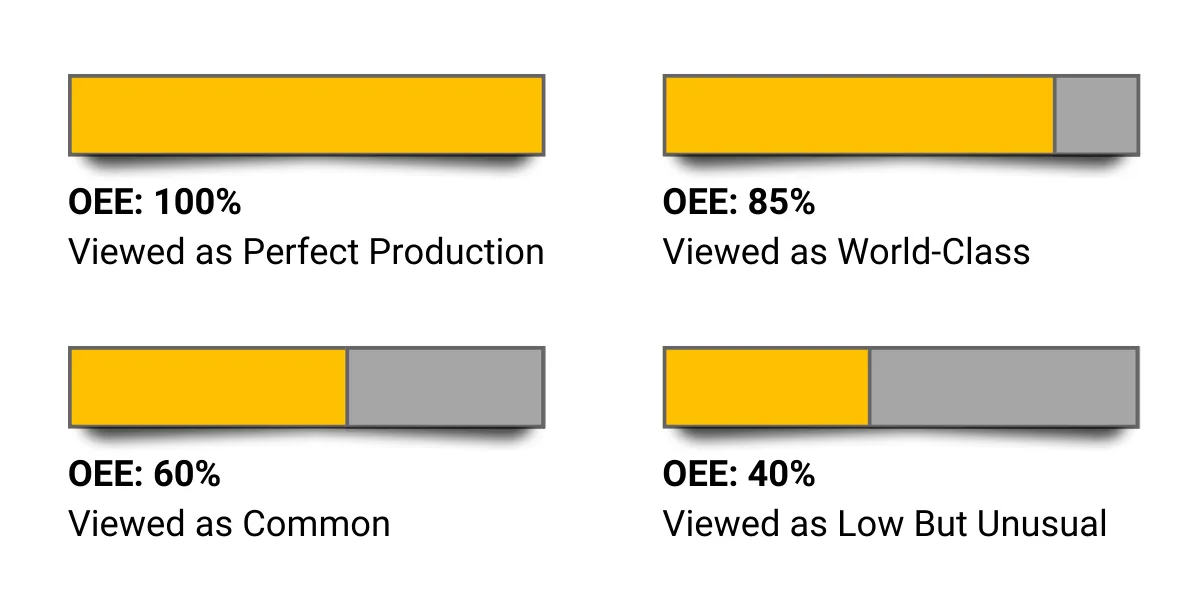
OEE scores range from 0% to 100%, with higher scores indicating better equipment performance and efficiency. Here’s how to interpret OEE scores:
- 100% OEE: Perfect performance, where equipment operates at maximum speed, without any downtime, and produces only good-quality products.
- 85% – 90% OEE: World-class performance, signifying highly efficient and productive equipment.
- 70% – 85% OEE: Good performance, with opportunities for improvement in availability, performance, or quality.
- Below 70% OEE: Indicates significant room for improvement, with potential issues in availability, performance, or quality that need to be addressed.
Benefits of OEE
- Performance Measurement: Overall equipment effectiveness provides a comprehensive and standardized method for evaluating equipment performance, allowing manufacturers to track progress and identify areas for improvement.
- Downtime Reduction: By pinpointing sources of downtime and inefficiency, OEE helps reduce unplanned downtime, optimize maintenance schedules, and enhance overall equipment availability. Integrating predictive maintenance applications can further help in preempting equipment failures.
- Increased Productivity: Improving OEE leads to higher productivity levels, increased throughput, and ultimately, better utilization of resources and higher profitability.
- Continuous Improvement: OEE serves as a catalyst for continuous improvement initiatives by fostering a culture of accountability, data-driven decision-making, and process optimization.
Conclusion
In conclusion, Overall Equipment Effectiveness (OEE) is a vital metric that enables manufacturers to assess equipment performance, identify areas of improvement, and enhance operational efficiency. By understanding the components of OEE and how it is calculated, organizations can streamline production processes, minimize downtime, and maximize productivity. Embracing OEE as a key performance indicator, alongside predictive maintenance solutions, industrial condition monitoring, and asset maintenance systems, empowers manufacturers to stay competitive, adapt to changing market demands, and drive sustainable growth in today’s dynamic manufacturing landscape.
The denominator is where this usually goes wrong, which is why Sensemore LAKE measures availability against the shift calendar rather than against the whole clock.
Frequently asked questions
What is Overall Equipment Effectiveness (OEE)?
OEE is a metric that evaluates the efficiency and productivity of manufacturing equipment by combining three factors: availability, performance, and quality. It gives a holistic view of equipment performance and helps manufacturers find inefficiency, reduce downtime, and raise productivity.
How is OEE calculated?
OEE = Availability × Performance × Quality. Availability is Run Time / Planned Production Time, where Planned Production Time is scheduled time minus planned downtime and Run Time is Planned Production Time minus unplanned stop time. Performance is (Ideal Cycle Time × Total Count) / Run Time, and Quality is Good Count / Total Count.
What is a good OEE score?
OEE scores run from 0% to 100%. 100% means perfect performance with no downtime and only good-quality output, 85–90% is world-class, 70–85% is good with room to improve, and below 70% indicates significant problems in availability, performance, or quality.
What are the three components of OEE?
Availability is the share of scheduled production time the equipment is actually available, accounting for breakdowns, changeovers, and planned maintenance. Performance measures operating speed against optimal speed, covering slow cycles, idling, and minor stoppages. Quality is the share of good products in total output.
Why is OEE important in manufacturing?
OEE gives a standardized way to measure equipment performance and track progress, pinpoints the sources of downtime so maintenance schedules can be optimized, raises throughput and resource utilization, and supports a culture of data-driven continuous improvement.