


Envelope analysis is a vibration diagnostic technique that extracts the amplitude envelope of a signal, the curve outlining its maximum amplitude variations, so that the modulations caused by faults such as gear damage or bearing defects stand out from the raw, noisy signal. By scrutinizing signal envelopes, maintenance teams gain a magnified view of machinery health, enabling timely intervention and enhancing overall reliability. This article covers the basics of vibration analysis, the fundamentals of the envelope, how it is acquired and extracted, the fault signatures it reveals, and a bearing failure case study.
Basics of Vibration Analysis
Vibration signals are fundamental indicators of machinery health, representing mechanical motion. These signals result from the dynamic interactions within rotating machinery components. Understanding these vibrations is crucial for assessing the condition of equipment. Vibration signals carry information about the frequency, amplitude, and phase of the mechanical oscillations, forming the basis for diagnostic analysis.
Frequency Domain Analysis
Frequency domain analysis involves decomposing vibration signals into their constituent frequencies. This process reveals the spectral content of the signal, identifying dominant frequency components. Common tools for frequency domain analysis include Fourier transforms and spectral analysis. This approach is valuable for pinpointing specific vibrational patterns associated with machinery faults, such as imbalances or misalignments.
Time Domain Analysis
Time domain analysis, in contrast, focuses on the signal’s behavior in the time dimension. It examines how the vibration signal evolves over time, providing insights into the temporal characteristics of machinery vibrations. Time domain techniques, like waveform analysis and statistical measures, offer a comprehensive understanding of the machinery’s dynamic behavior, aiding in the identification of transient events and irregularities.
Limitations of Traditional Analysis Methods
While traditional vibration analysis methods provide valuable insights, they have limitations. These methods may struggle to detect early-stage faults or subtle anomalies hidden within the signal, especially in complex industrial environments with high levels of background noise. Additionally, traditional approaches may lack the sensitivity required to identify certain fault types, necessitating the integration of more advanced techniques like envelope analysis.
Envelope Analysis Fundamentals
Definition of Envelope
The envelope in signal processing refers to a curve outlining the maximum amplitude variations of a signal. In the context of machinery diagnostics, the envelope represents a smoothed version of the vibration signal, highlighting changes in amplitude over time. It is particularly instrumental in capturing modulations within the signal associated with various faults and irregularities.
Significance in Identifying Modulations
The envelope’s primary significance lies in its ability to capture modulations within the vibration signal. Modulations are periodic variations in amplitude that often indicate the presence of faults or abnormalities in rotating machinery. Envelope analysis excels at isolating these modulations, providing a clear and distinct representation of the underlying fault signatures that might be obscured in the raw vibration signal.
Comparison with Raw Vibration Signal Analysis
Comparing envelope analysis with traditional raw vibration signal analysis underscores its superiority in fault detection. While raw signals offer a detailed but noisy representation of machinery vibrations, envelope analysis provides a refined, high-level perspective. By focusing on amplitude variations, envelope analysis effectively filters out irrelevant details, making it more sensitive to subtle changes associated with developing faults.
| Aspect | Raw vibration signal analysis | Envelope analysis |
|---|---|---|
| Representation | Detailed but noisy representation of machinery vibrations | Refined, high-level perspective focused on amplitude variations |
| Irrelevant detail | Retained in the signal alongside the fault information | Effectively filtered out |
| Developing faults | Subtle changes can be obscured within the raw signal | More sensitive to the subtle changes that accompany developing faults |
Advantages of Envelope Analysis
- Increased Sensitivity: Envelope analysis enhances sensitivity to early-stage fault detection, making it possible to identify issues before they escalate.
- Effective in Noisy Environments: In industrial settings with significant background noise, envelope analysis stands out by isolating fault-related modulations from the surrounding noise, improving signal clarity.
- Fault Signature Magnification: Envelope analysis acts as a diagnostic magnifying glass, amplifying fault signatures that may be subtle or masked in the raw signal.
- Proactive Maintenance: The ability to detect faults early enables proactive maintenance, reducing downtime and extending the overall lifespan of machinery.
Signal Acquisition and Preprocessing
Signal Conditioning and Amplification
Raw signals acquired from sensors often undergo signal conditioning to prepare them for analysis. Signal conditioning involves processes like amplification, analog-to-digital conversion, and filtering. Amplification increases the strength of the signal, ensuring that subtle vibrations are not overshadowed by noise. Proper signal conditioning is essential for maintaining signal integrity throughout the analysis.
Importance of Proper Sensor Placement
The placement of vibration sensors is a critical factor influencing the accuracy of data acquisition. Sensors should be strategically positioned to capture vibrations directly related to the machinery’s health. Proper sensor placement ensures that the acquired signals accurately reflect the condition of key components, such as bearings, gears, or rotating shafts. Incorrect sensor placement may lead to misleading or incomplete data.
Filtering Techniques to Enhance Envelope Extraction
Effective envelope extraction relies on pristine signals, making filtering crucial in the preprocessing stage. Filtering techniques, such as bandpass filters, help isolate specific frequency bands of interest. This step is particularly important for envelope analysis, as it enhances the extraction of modulations associated with machinery faults while minimizing interference from irrelevant frequency components or background noise.
Envelope Extraction Techniques
Hilbert Transform and its Role in Envelope Analysis
The Hilbert transform plays a central role in envelope analysis by providing a means to extract the analytic signal from a real-valued vibration signal. It achieves this by shifting the phase of the original signal by 90 degrees, producing a complex signal that encapsulates both amplitude and phase information. The envelope is then obtained by calculating the magnitude of this analytic signal, emphasizing the signal’s amplitude variations over time.
Analytic Signal Representation
The analytic signal representation encompasses both the original signal and its Hilbert transform, creating a complex signal that facilitates a comprehensive analysis of amplitude modulations. By incorporating both real and imaginary components, the analytic signal captures the instantaneous amplitude and phase characteristics of the vibration signal. This representation is pivotal for discerning modulations indicative of machinery faults.
Demodulation Techniques
Demodulation techniques are employed to isolate the low-frequency components associated with machinery faults from the high-frequency carrier signal. By demodulating the analytic signal, practitioners can extract the envelope, effectively highlighting the variations in amplitude that signify potential faults. Demodulation is particularly valuable in separating the fault-related modulations from the overall vibration signal.
Envelope Extraction Algorithms (e.g., Empirical Mode Decomposition)
Envelope extraction often involves sophisticated algorithms, with one notable approach being Empirical Mode Decomposition (EMD). EMD breaks down a complex signal into a set of intrinsic mode functions (IMFs) that represent the signal’s oscillatory components at different scales. The envelope is then extracted from these IMFs, allowing for a detailed analysis of the amplitude modulations associated with specific fault frequencies.
Fault Signatures in Envelope Analysis
Gear Tooth Damage and Modulation Effects
Gear tooth damage is a common issue in rotating machinery, and envelope analysis proves highly effective in its detection. As gears wear or suffer damage, modulations in the vibration signal occur at harmonics of the gear mesh frequency. Envelope analysis accentuates these modulations, enabling the early identification of gear tooth damage through the distinctive patterns observed in the envelope.
Bearing Defects and their Impact on the Envelope
Bearing defects, such as pitting or spalling, introduce characteristic modulations in the vibration signal. Envelope analysis amplifies these modulations, making it possible to identify the specific frequencies associated with bearing faults. By focusing on the envelope, analysts can pinpoint the early stages of bearing deterioration, facilitating timely intervention and preventing catastrophic failures.
Misalignment and its Manifestation in the Envelope
Misalignment in rotating machinery causes modulations in the vibration signal at frequencies related to the rotational speed and the misalignment itself. Envelope analysis discerns these modulations, providing a clear indication of misalignment issues. Identifying misalignment through envelope analysis allows maintenance teams to rectify the problem promptly, preventing further damage to components and optimizing machinery performance.
Other Common Faults Detected through Envelope Analysis
- Imbalance: Imbalances in rotating components lead to modulations in the vibration signal, particularly at the rotational frequency. Envelope analysis enhances sensitivity to these modulations, aiding in the detection of imbalance issues.
- Looseness: Loose components generate impact forces, resulting in modulations in the vibration signal. Envelope analysis helps distinguish these modulations from background noise, facilitating the early detection of loosening in machinery.
- Belt or Coupling Issues: Envelope analysis is effective in detecting faults related to belts or couplings, such as slippage or wear. The modulations caused by these issues are highlighted in the envelope, allowing for targeted diagnostics.
Envelope Analysis Case Study: Bearing Failure
Failure of bearings can cause long-term downtime of the entire machine and even the production line. Since bearing failures constitute 41% of the failure modes of electric motors and fail much earlier than their estimated working life, continuous monitoring and fault prediction of bearings becomes a great necessity.
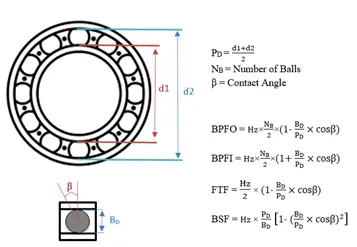
The operation of machine components always produces vibration. Bearing failures often cause changes in vibration patterns. These vibrations can be measured with sensors mounted at the right points of the machine. The measured vibration signals are digitized and processed. Through various signal analysis techniques, relevant fault signal components can be extracted and examined. In this way, bearing faults and defects can be detected and isolated. The main thing in vibration analysis is harmonic analysis. The drive frequency and its harmonics are analyzed by the sidebands of these harmonics. However, it does not coincide with the exact multiples of the drive frequency in bearing failures. Abrasions in bearings caused by reasons such as insufficient lubrication, incorrect assembly, fluting create vibrations at specific frequencies. Since we know that bearings have 4 basic mechanical parts as outer ring, ball, cage and inner ring, each part has its own specific failure frequency. These fault frequencies are BPFO (Ball Pass Frequency Outer), BSF (Ball Spin Frequency), FTF (Fundamental Train Frequency) and BPFI (Ball Pass Frequency Inner). Each one follows from the bearing geometry and the speed of the shaft it carries, and the bearing fault frequency calculator works out all four.
Band Selection
It is necessary to select a frequency range in the vibration spectrum where bearing failure occurs and remove all components outside the band. It is assumed that this selected frequency range relates only to bearing failures and not to other machine failures. The optimum range of the frequency band that combines the characteristic frequency of this bearing failure with the structural resonance of the systems can also be manually selected and put into the Inverse Fourier Transform, and it can also be automated with spectral kurtosis, EMD (Empirical Mode Decomposition) and other optimization algorithms.
Envelope Spectrum
The signal is modulated by selecting the band gap combining the characteristic frequency of the bearing failure with the structural resonance of the systems and taking the Inverse Fourier Transform. Then the modulated signal in time-wave form is enveloped by Hilbert Transform. The Envelope Spectrum is obtained by taking the Fourier Transform of the enveloped signal again. The predominant presence of vibrations at the bearing failure frequencies mentioned above in the Envelope Spectrum will indicate bearing failure.
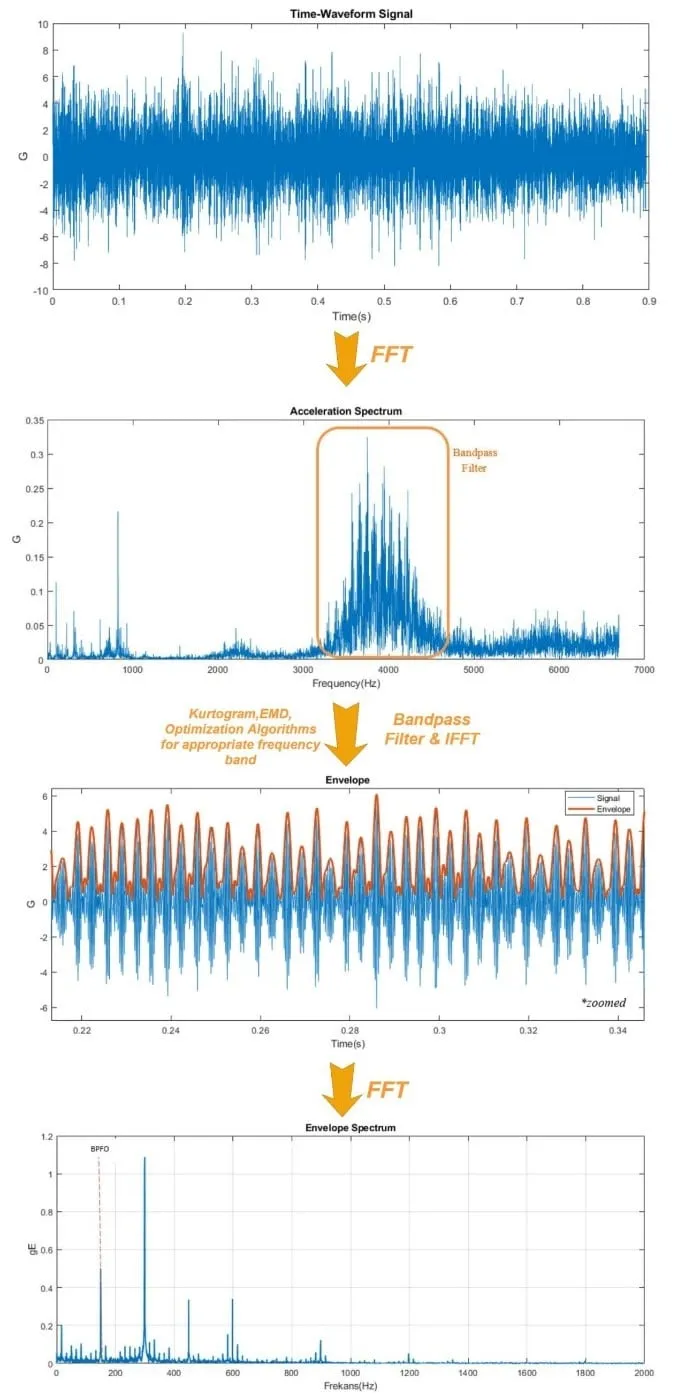
Fig. 1 Failure Mode Diagram
Conclusion
Based on the evaluation of the amplitude modulation of random vibration and structural resonance, envelope analysis is one of the effective ways to detect and evaluate the condition of a bearing. Using Hilbert Transform instead of filtering and correction in envelope detection provides phase demodulation and frequency demodulation as well as amplitude demodulation for bearing fault diagnosis. Frequency demodulation paves the way for gearbox diagnostics and troubleshooting of problems caused by torsional vibrations.
Sensemore LAKE plots the same relationship directly, resonance against running speed for a sensor point, built from measurements that had already been collected.
Frequently asked questions
What is envelope analysis?
Envelope analysis is a vibration diagnostic technique that targets the amplitude variations of a signal rather than the raw signal itself. The envelope is a curve outlining the maximum amplitude variations, and isolating it exposes the modulations that indicate faults such as gear damage or bearing defects.
Why is envelope analysis better than raw vibration signal analysis?
Raw signals give a detailed but noisy representation of machinery vibrations, whereas envelope analysis gives a refined, high-level view focused on amplitude variations. By filtering out irrelevant detail it becomes more sensitive to the subtle changes that accompany a developing fault.
How is the envelope extracted from a vibration signal?
The Hilbert transform shifts the phase of the original signal by 90 degrees to produce an analytic signal that carries both amplitude and phase information; the envelope is the magnitude of that analytic signal. Demodulation then separates the low-frequency fault components from the high-frequency carrier, and algorithms such as Empirical Mode Decomposition can break the signal into intrinsic mode functions first.
Which faults can envelope analysis detect?
It detects gear tooth damage, which modulates the signal at harmonics of the gear mesh frequency, bearing defects such as pitting or spalling, misalignment, imbalance, looseness, and belt or coupling issues such as slippage or wear.
Why is envelope analysis used for bearing faults?
Bearing failures constitute 41% of the failure modes of electric motors and often occur far earlier than the estimated working life. Each of the four bearing parts (outer ring, ball, cage and inner ring) has its own characteristic fault frequency (BPFO, BSF, FTF and BPFI), and a predominance of vibration at those frequencies in the envelope spectrum indicates a bearing failure.